Lesson Stacks

CRAFT resources are intended to be adapted and fit easily into your curriculum plans.

However, if you are interested in spending several days on a specific topic, we have some stacks of CRAFT resources that we suggest using together in a recommended sequence.


This is a collection of constantly growing and developing resources. Be sure to check back regularly for new resources.

Got feedback or questions? Reach out to the CRAFT team via our contact form.

Is AI Fair? Bias, Data, and Responsibility

This stack invites students to examine AI as a system shaped by human choices and therefore open to scrutiny, rather than as a neutral tool. Beginning with the foundations of algorithmic bias, students move toward understanding how bias affects real-world applications, then confront its global consequences, especially for communities in the Global South who are rarely centered in AI development. From there, students turn to questions about how their own data is collected and used, before arriving at a capstone lesson that asks them to articulate the principles that should guide ethical AI use. Together, these five lessons build a progressive argument that recognizing bias is only the first step and that responsibility requires attention to whose voices are included, whose data is used, and what values guide design decisions. This stack is well suited for social studies, ethics, or interdisciplinary AI literacy courses.
  • 5 lessons
  • Created by Bernardo Silveira
A stack of playing cards that are colorful and have robots

What principles should guide ethical use of AI?

View Lesson
This gamified lesson effectively introduces students to the ethical challenges of AI. It boosts critical thinking and ethical reasoning through engaging discussions. It also enhances collaborative skills and decision-making, providing a rich learning experience.

How does bias in AI affect the Global South?

View Lesson
This lesson explores the impact of biased data on AI systems with a focus on the Global South. Students will learn how biased data leads to biased results since AI reflects the data it is trained on. In particular, students will focus on the impact of this on countries that are generally less industrialized and have lower income levels than developed nations in the Global North.

How does algorithmic bias impact different AI applications?

View Lesson
In this lesson, students start to understand the possible consequences of algorithmic bias. They consider a range of applications for which algorithmic bias presents a problem. This could be the 2nd lesson of a 2 part sequence.
AI Generated image of scales where the right side scale being lower than the left

What is algorithmic bias?

View Lesson
In this lesson, students are introduced to the concept of algorithmic bias. Students play a game that illustrates the concept through a hiring simulation. This could be the 1st lesson of a 4 part sequence.
a hand holding a cell phone

How should (or shouldn’t) my data be used in AI Algorithms?

View Lesson
In this lesson, students are introduced to the concept of a digital footprint. They consider data publicly available about them online, including on social media. Then, they consider the ethics of having their data used in AI algorithms.

AI and the Environment: Costs, Solutions, and Hard Choices

This stack asks a simple question: does AI help or harm the planet? Students begin by confronting an uncomfortable fact, that AI itself consumes significant energy and water, before exploring how AI is being applied to combat climate change and expand renewable energy. The stack then turns to a concrete application, examining how AI-powered forecasting models help communities prepare for floods, a growing threat as climate change intensifies. The sequence closes with a debate lesson asking students to weigh everything they have learned and form their own evidence-based position on whether AI's environmental costs are justified by its benefits. Rather than presenting AI as either a solution or a problem, this stack pushes students toward nuanced judgment about real trade-offs. This stack is well suited for science or environmental studies classrooms.
  • 5 lessons
  • Created by Bernardo Silveira
AI Quests

How can AI help a community prepare for a flood?

View Lesson
Floods are among the world’s most devastating natural disasters, affecting millions of people each year. Today, scientists are using AI flood forecasting models to predict when and where floods may occur, giving communities more time to prepare and stay safe. But these predictions are not perfect. Data can be messy, and humans have many important steps to take in order to build trustworthy AI models that can help with decision-making. In this lesson, students will play Market Marshes, an AI Quest to explore how AI predicts floods, consider challenges with data accuracy, and reflect on the human responsibilities involved in making decisions with AI.
renewable energy

How is AI advancing renewable energy innovation and deployment?

View Lesson
The global transition to renewable energy is crucial for sustainability and AI is enhancing its efficiency and accessibility. However, both renewable energy projects and AI-driven solutions raise ethical concerns, from environmental impact to data privacy and energy equity. In this lesson, students will explore how AI is advancing renewable energy and conduct brief research on the ethical dilemmas associated with both renewable energy projects and AI applications.
healthy and thriving planet

Will AI do more harm or good for the planet?

View Lesson
AI is already being used in many ways to combat climate change. Yet, building, training, and using AI comes with an enormous environmental footprint. Will AI ultimately do more harm or good for the planet? In this lesson, students will draw on their prior learning about the potential and pitfalls of AI for the planet and form their own opinions on whether the advantages of AI outweigh its environmental costs. Then, they will explore potential solutions for making AI more sustainable.
melting glacier due to climate change

How can AI help combat climate change?

View Lesson
AI is already being used to diagnose diseases, make art, and accelerate learning. But can AI help the planet? In this lesson, students will explore a variety of ways that AI is already being used to combat climate change. By examining diverse example use cases, they will begin to construct a framework for the types of problems that AI can help address.
future tree

What are the environmental costs of AI chatbots?

View Lesson
Scientists are already using AI to map environmental risks, analyze huge amounts of climate data, and make predictions to combat climate change. But AI technologies like chatbots also use an enormous amount of energy, and many people are concerned with their environmental costs. In this lesson, students will investigate how these technologies consume energy and water and the broader impact of AI on sustainability.

Who is the Artist? AI and the Future of Creative Work

This stack explores how generative AI is reshaping creative practice across visual art, music, and writing, inviting students to question assumptions about what creativity means and who, or what, can be creative. Students begin by debating whether AI is disrupting or expanding traditional art-making, then examine specific generative tools used to produce visual artwork. The stack continues into music, where students experiment with composing using generative AI, before turning to language arts, first exploring AI's role in storytelling broadly, then applying the same lens to narrative writing in an English classroom. Across all five lessons, students will be invited to weigh AI's creative possibilities against its limitations, considering questions of authorship, originality, and the human role in the creative process. This stack is well suited for art, music, and language arts classrooms.
  • 5 lessons
  • Created by Bernardo Silveira

Can AI help with storytelling?

View Lesson
Good storytelling involves crafting a narrative that captivates an audience and resonates with them. Can AI help tell stories that speak to the human imagination? AI tools have opened up possibilities in story creation allowing for help with idea creation, story format and writing. In this lesson, students will explore how AI can be used in storytelling including how to consider the benefits and trade-offs of incorporating AI into the storytelling process.
art-work showing a woman

Is AI disrupting art?

View Lesson
As AI-generated art becomes more widespread, artists and technologists are debating its role in the creative process. Is AI disrupting traditional artmaking—or expanding it? And who gets credit for AI-generated work? In this lesson, students will explore these questions by examining how AI is impacting creativity, artistic identity, and the definition of art itself. After analyzing diverse perspectives, students will be introduced to prompt engineering as a tool for generating both reinterpretations of existing art and new, original work. This lesson is designed for integration in both computer science and art classrooms.

How can students create music with generative AI?

View Lesson
Generative AI (GenAI) models now write and produce songs according to user preferences, whether they enjoy classical violin or reggaeton or something in between. Can people without access to studios make music with AI? How do these new AI tools interact with the music industry landscape? In this lesson, students will expand their knowledge of the AI-generated music landscape and begin to explore how they can create their own music with AI.
Painting of a girl looking into a colorful sky

How is AI transforming visual artwork creation?

View Lesson
Art has long been a uniquely human form of expression, but what happens when machines begin to create? From surreal portraits to abstract landscapes, AI is generating visual art that is changing our ideas about creativity. In this lesson, students will explore how AI is transforming art generation, examining its processes and how it’s reshaping the future of expression. Students will also examine how generative models, like Firefly, work and assess their global implications.
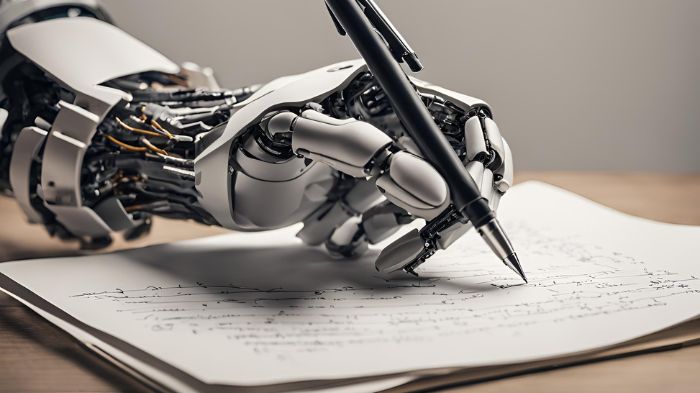
A robotic hand writing on a piece of paper

How can Generative AI support narrative writing in English class?

View Lesson
In this lesson, students will explore how AI tools like ChatGPT can assist with narrative writing. They will assess the strengths and limitations of using AI for creative writing and learn how to balance AI capabilities with their own creativity.